
Views: 0 Author: Site Editor Publish Time: 2026-10-12 Origin: Site


CNC machining is not simply "loading a program and pressing start." Behind every precision part is a deliberate process plan: how to hold the workpiece, which surfaces to cut first, which tools to use, and how to sequence roughing and finishing so that dimensional accuracy and surface quality are achieved reliably.
This guide walks through the actual machining process—from process planning to cutting mechanics to special operations—so engineers and buyers understand what happens on the shop floor.
After receiving a part drawing, the process engineer must answer three questions: how to machine it, how many stages are needed, and in what order.
The method depends on the surface feature and its precision requirement. Planes and contours are milled. Revolved features are turned. Holes are drilled, reamed, bored, or helical-milled depending on tolerance. For a hole with IT9 tolerance, a drill-and-ream sequence works for diameters under 10 mm, while a drill-and-bore sequence is preferred above 30 mm.

The rule is rough first, finish last. Roughing removes the bulk of the material quickly. Semi-finishing corrects the shape and leaves uniform stock. Finishing achieves the final dimensional tolerance and surface finish.
For high-precision parts, it is best to leave time between roughing and finishing so internal stresses can release naturally. When required, an artificial aging treatment can be scheduled between stages.
Two fundamental rules govern operation order:
Datum surfaces are machined first. A more accurate locating datum reduces clamping error in every subsequent setup.
Planes before holes. A flat, stable surface locates the part better and prevents drill deflection.
CNC machining is fundamentally relative motion between tool and workpiece. A rotating tool (milling) or rotating workpiece (turning) combines with feed motion to remove material layer by layer.
Milling rotates the tool while the workpiece remains stationary. The tool moves along X, Y, and Z axes to produce planes, slots, pockets, and complex 3D surfaces.
Turning rotates the workpiece while the tool feeds linearly. It is suited to cylindrical surfaces, faces, threads, and revolved profiles.
Roughing prioritizes efficiency: simple tool paths (mostly straight lines), maximum depth of cut and feed rate, fast material removal. Finishing prioritizes accuracy: the tool follows the contour, and deviation must stay within tolerance. Semi-finishing removes the steps left by roughing and leaves uniform stock for finishing.

Plane machining: Rough milling → finish milling. Rough milling holds dimensional tolerance around IT12–IT14 with surface roughness Ra 12.5–50 μm. Finish milling achieves tighter accuracy.
Small holes (no pre-cast bore): Spot face → center drill → drill → ream → chamfer → ream finish. Chamfering is scheduled before final finishing to prevent burrs inside the hole.
Large holes (with pre-cast bore): Rough bore → semi-finish bore → chamfer → finish bore. Holes larger than 30 mm can also be helical-milled with an end mill.
Threads: M6–M20 are tapped. Threads below M6 have their pilot holes machined on the machining center, but tapping is done on separate equipment because small taps break easily. Threads above M20 are bored with a threading insert.
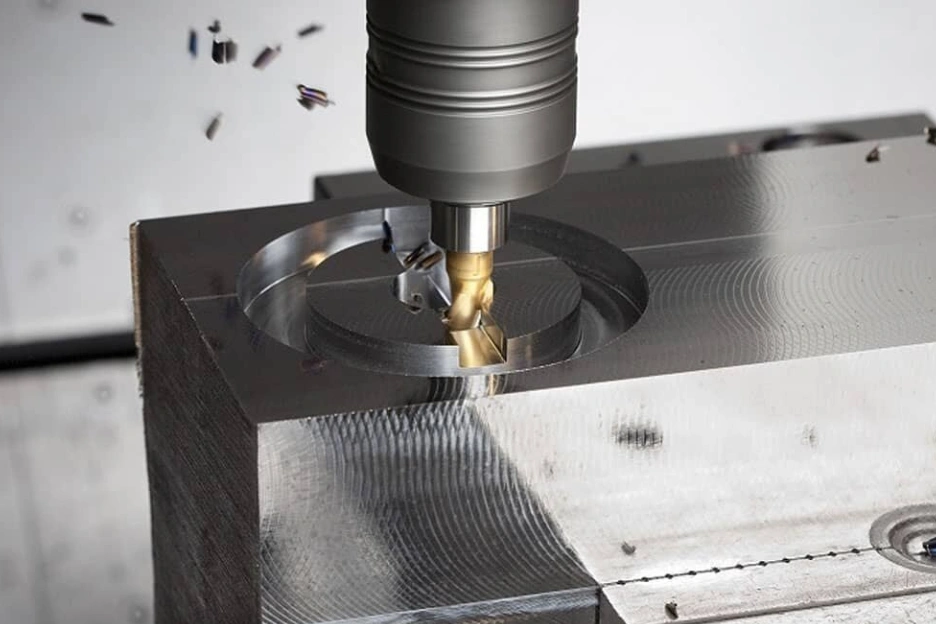
Pocket machining is the most common milling scenario—over 80% of machined parts fall into this category. The basic method is contour offsetting: the tool path is offset outward from the pocket boundary by one tool radius so the tool just reaches the wall.
One critical constraint: the tool radius must be smaller than the minimum curvature radius of the pocket boundary. Otherwise the tool will gouge the corner. If the pocket has sharp internal corners, a smaller tool is needed for corner cleanup.
Tool change strategy affects efficiency. The principle is: finish everything one tool can do before changing to the next tool. Machining centers commonly use "operations grouped by tool" to minimize tool changes.
Sinker EDM (electrical discharge machining) uses a shaped electrode to burn a cavity into conductive material. The electrode is submerged in dielectric fluid, and high-frequency sparks generate localized temperatures of 8,000–12,000°C, melting and vaporizing material. It handles hardened steel, tungsten carbide, and deep narrow slots or sharp corners that conventional tools cannot reach.
Wire EDM uses a thin metal wire (0.03–0.35 mm diameter) as the electrode, cutting along a programmed path. Any conductive material can be machined regardless of hardness. It is ideal for stamping dies, precision parts, and complex profiles—almost any planar shape can be produced.
A mature CNC process plan must cover the following:
Locating datum — clearly defined and reliable
Workholding method — avoids over-constraint or under-constraint
Tool selection — matched to material and feature
Cutting parameters — speed, feed, and depth within tool and machine limits
Inter-stage treatment — stress relief or aging where necessary
Inspection points — scheduled after critical operations
There is no single correct process design. The same part can be machined in one setup on a machining center, or distributed across milling, turning, and drilling machines in separate operations. The choice depends on batch size, precision requirements, available equipment, and cost budget.





 English
 简体中文
简体中文