
Views: 0 Author: Site Editor Publish Time: 2026-08-01 Origin: Site


The electronics industry relies heavily on precision machining to produce components that are compact, complex, and highly reliable. CNC (Computer Numerical Control) machining is a cornerstone of this manufacturing process, offering the accuracy and consistency required for everything from consumer gadgets to advanced communication equipment.
Several CNC processes are commonly used in electronics manufacturing, each suited to different part geometries and requirements.

CNC machining is used to manufacture a wide array of components for electronic devices.
Housings and Casings: CNC milling is ideal for creating enclosures for smartphones, laptops, and other devices. It ensures precise wall thicknesses, complex internal features (like mounting bosses), and smooth surfaces for a premium appearance.
Heat Sinks and Thermal Management: High-power electronics generate significant heat. CNC machining allows for the creation of precise fin geometries in materials like aluminum and copper, maximizing surface area for efficient heat dissipation.
Connectors and Mounting Parts: From SIM trays to USB-C ports and RF connectors, CNC turning and milling produce parts that require exact dimensions and surface smoothness to ensure reliable electrical connectivity and mechanical fit.
Structural Components: Brackets, support frames, and other structural parts provide essential support for PCBs, displays, and sensors. CNC machining ensures high strength, dimensional accuracy, and the ability to withstand vibration.
Small Precision Parts: This category includes items like pins, terminals, and sensor carriers. Their size often demands Swiss turning or micromachining to achieve the necessary tolerances.
The widespread use of CNC machining in the electronics industry is driven by several key benefits.
High Precision and Tight Tolerances
Electronic components often require micron-level accuracy to fit together properly in densely packed assemblies. CNC machines can consistently achieve tolerances as tight as ±0.0005 inches on critical mating surfaces, which is essential for features like snap-fits or antenna bands.
Excellent Surface Finish
The appearance of consumer-facing parts is crucial. CNC milling can deliver cosmetic-grade surfaces, such as bead-blasted and anodized finishes, with minimal tool marks. This not only enhances the product's look and feel but also improves the quality of subsequent finishing processes. Burr-free edges also reduce post-processing labor and assembly issues.
Complex Geometry Capability
Modern electronics are increasingly thin and lightweight, requiring parts with complex micro-structures like deep grooves, thin walls, and intricate contours. Multi-axis CNC milling (3, 4, and 5-axis) can produce these shapes in a single setup, reducing errors and manufacturing time.
Superior Repeatability for Mass Production
CNC machines are program-controlled, ensuring that every part from a large production run is identical. This high repeatability is vital for the electronics industry, which often ships millions of units, as it simplifies quality control and automated assembly.
Accelerated Prototyping and Iteration
The electronics industry moves quickly. CNC machining does not require expensive tooling like injection molds, making it ideal for rapid prototyping. Engineers can quickly test designs, make revisions, and validate concepts before committing to mass production, significantly shortening the overall development cycle.
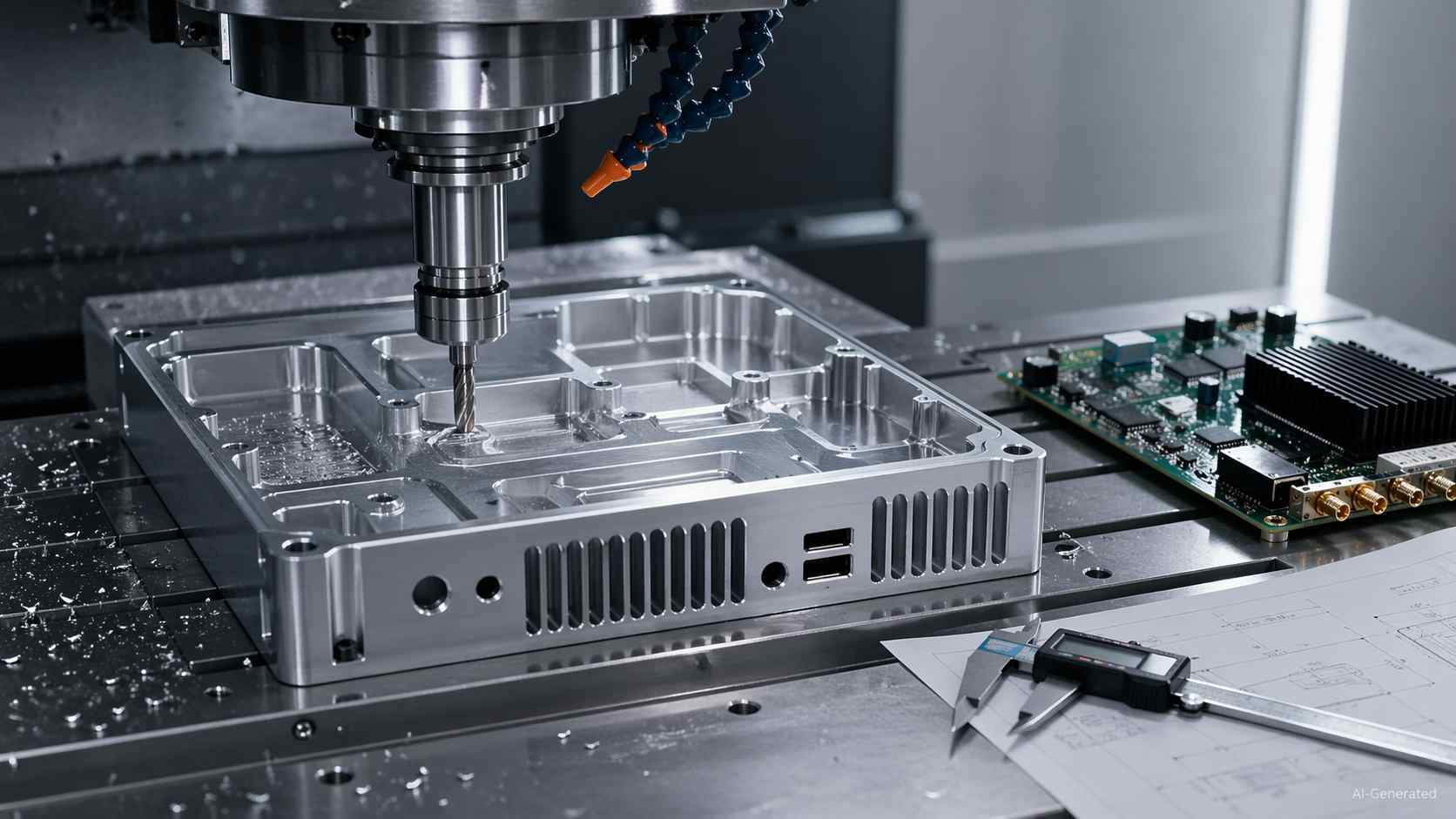
CNC machining is adaptable to a wide range of materials common in electronics. Aluminum alloys (like 6063 and 6061) are popular for housings and heat sinks due to their lightweight and good thermal properties. Stainless steel (316, 304) and titanium are used for parts requiring higher strength or a premium finish. Engineering plastics are also commonly machined for insulating components



 English
 简体中文
简体中文